

The Medicine Doctor of the Baviaanskloof
Deep within the folds of the Cape Fold Mountains in the Eastern Cape of South Africa lies the Baviaanskloof. We drive west from Patensie, following every twist of the gravel road, eyes fixed on the cliffs that rise on both sides. They climb higher and higher into the sky (up to 1,500 m high), and just when it feels as if they are about to bury us beneath the earth, the bright ribbon of the river suddenly appears.
We have arrived in the Baviaanskloof!
Nestled between the Kouga and Baviaanskloof ranges, the Baviaanskloof is one of South Africa’s largest and most untouched World Heritage sites. We tackle the Kloof Road, which winds for more than 200 km alongside the river. Deep and narrow, the dark river flows, only broken here and there by a foaming, white waterfall. We cross Doodskloof Pass, travel past Bergplaas and Smitskraal and climb to Grasnek with its breathtaking views. We then squeeze through the Poortjies – the narrow gateway between the cliffs – and finally reach Die Plaat with its vast open plains. On the last stretch toward Kamerkloof and Sewefontein, we stop at Makkedaatjie.
The great overhanging rockshelter at Makkedaatjie, painted with San images of eland, people and geometric patterns, brings us face to face with Khoisan history – a story etched into these gorges and mountains for more than 150 000 years. A stone’s throw further on lies a deep, dark pool where the river disappears beneath the cliffs: still, black water with silver reflections and slow-moving shadows that come and go.
A faintly mystical feeling comes to settle with us here.
I think we are now ready to meet Oupa Klaas of Sewefontein.
Background
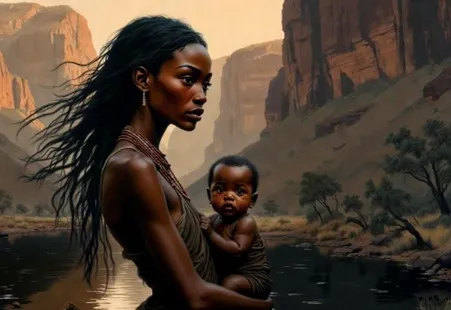
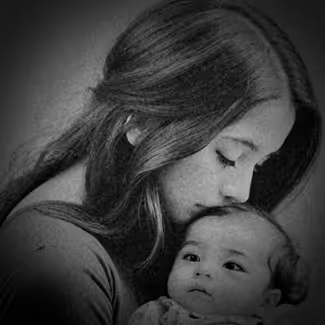
The ancient San hunters regarded the water spirit !Khwa as the “elder sister of the rain” (Bleek & Lloyd, 1911). They said !Khwa always carries a baby on her hip – but it is not her own. The child belongs to the Rain Spirit that has not yet been born. In old Khoisan belief, !Khwa is not merely a symbol of water – she is the water itself. She did not simply live in the dark pools beneath the Baviaanskloof cliffs; she was those waters. The /Xam people called her !Khwa-ka !khwa: “The Water’s Water”, the very essence of everything that flows and hides.
!Khwa has a firm but fair nature. Approach her with respect, offer a little tobacco or a song, and she will stroke your tender skin with wet fingers and show you where Katjie Drieblaar grows. She makes white patches vanish and carries your bladder pain away into the black current. But arrive shouting, throwing stones or cursing, and her long hair turns into ropes that seize your ankles and drag you beneath the surface. And then? No one knows what becomes of you.
Because she is the elder sister of the Rain Spirit, !Khwa commands the first summer storms. When she combs her wet hair in the sun, the drops that fall on the rocks become the first rains after winter. With a single enchantment, she transforms the dry Karoo into green pastures where game can graze in endless herds. Also, every plant that grows beside her rivers carries a trace of her power in stem and leaf. That is why she is also the guardian of the veld’s healing herbs.
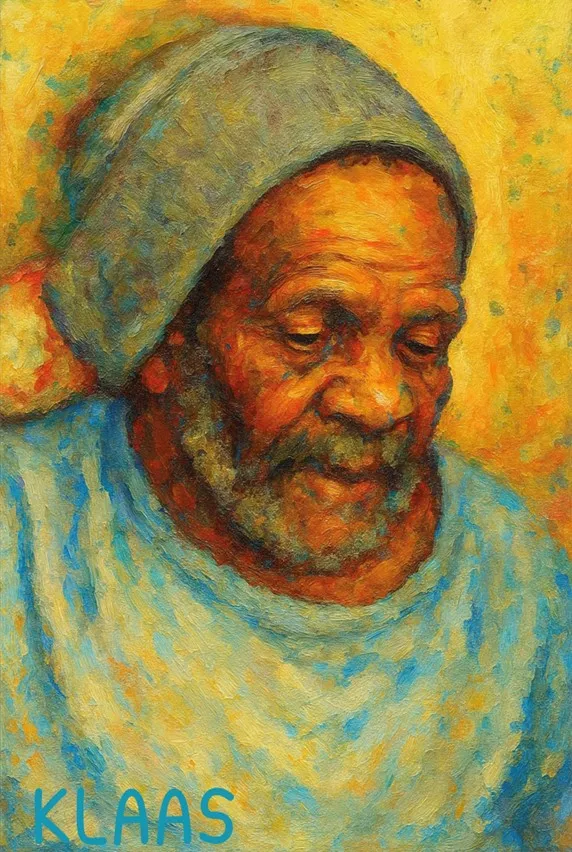
Oupa Klaas Swart is one of the last Khoisan herbalists in the Baviaanskloof. He sits on his bed, back against the wall, a knitted cap keeping his head warm. Only one leg remains, and his blind eyes drift dimly about, following the sounds that tumble around the room. We greet him politely. Oupa Klaas gives a slight, uncertain smile, unsure what our visit might mean. There are many questions, but he answers patiently. Slowly, he relaxes. As the voices and sounds around him become familiar, his own words begin to roll more easily over his tongue. And a spark from the ancient Khoi fires that still smoulder somewhere in his spirit flashes briefly in his fading eyes.
While we sit with him, Oupa Klaas tells us about the Water People and explains the medicinal plants of the Baviaanskloof mountains. He laughs about the cheeky baboons who steal Rooiwortel and about how he has begun training his granddaughter, Chunayda Windvogel, so that one day she can take over from him as Medicine Man. Chunayda smiles – shy and proud at the thought.
And the future?
Today, we listen and look at the long shadows cast by the Khoi and the San from the distant past. The feet that anchor those shadows are all our feet, stretching back 150,000–300,000 years to the very origin of our species, Homo sapiens. And those very first people walked here too, beside the Baviaanskloof river.
The San are literally the oldest family of humankind on earth.
The oldest people outside Africa are the Aboriginal Australians, with a history of more than 65,000 years. And the difference?
Where the voices of the San have almost all fallen silent as their languages die out, Australia’s First Nations still sing loud and strong.
That is the great and sorrowful difference.
And the future for the Khoisan?
It hangs in the balance like a Khoi child in a soft eland-skin kaross. Those of us who come from outside will have to help – not just to quiet our own consciences, but because our own shadows are knotted to the feet of the Khoisan.

Photo Gallery

The Song of Tap
an ode to the senses




.png)




Not a subscriber yet?
Click here to subscribe - it's free
Share to a friend
Take a moment to pass along the story to a friend or family. Your recommendation might be exactly what someone in your circle needs to read today. The best stories are those that bring people together.
I'd love to know your thoughts about this story, feel free to leave a comment.
.svg)
.svg)
Lorem ipsum dolor sit amet, consectetur adipiscing elit. Suspendisse varius enim in eros elementum tristique. Duis cursus, mi quis viverra ornare, eros dolor interdum nulla, ut commodo diam libero vitae erat. Aenean faucibus nibh et justo cursus id rutrum lorem imperdiet. Nunc ut sem vitae risus tristique posuere.
