


The Mirage of Happiness
We were driving through the Etosha National Park in the far North of Namibia in the winter of 2024, where I took the photo of this Springbok. The ram lies alone in the midday sun far out on the endless, scorched plains of Etosha (“The Great White Place” in the Ndonga language1).
Out here on the plains, he does not need the alert protection of the herd; he will see the unlikely approach of a predator from miles away. Out here, there is no competition in the mating season, no stress, no rage, no fights. This is the time and place to lie down in the warm winter sun, drink in the peace and dream with eyes half closed while chewing the cud2.
This is his Happy Place.
But there is no water and no food in this place. There is no company. The heat that warms now might kill tomorrow. The green, lush pastures remain a mirage beyond the horizon. This place will not offer the euphoria of winning a battle, leading the herd, or mating with a doe.
Yet, this is his Happy Place.
Welcome to this edition of From a Distance.
Please sit down and comfort your mind.
Think for a moment about what makes you happy.
Perhaps, we can find a way to make this prized emotion become an everyday prize experience.
Looking Happiness in the eye, it introduces itself as a bipolar experience where we teeter on a see-saw, chasing the ups and trying to survive the downs.
Let’s accept that for a moment.
Now, to better understand the light side of Happiness, we first need to page through the dark side, facing the morbid mood of depression.
This will be challenging. So, when you’re ready, please bear with me for a while.
Mr Beta was young, if I remember correctly, about 28 or 29 years old. He had a pain in his foot that started approximately 10 months earlier. No, he did not injure his foot, and his work and leisure time exposures did not contribute. No, he had never experienced this before. No, he did not have any other pains. I examined the foot, his gait, and then his entire musculoskeletal and neurological systems, but could not find anything wrong. I asked if he felt the pain was troubling enough to warrant further investigation.
Mr Beta did not try to hide his annoyance with my question. Of course, he wanted it investigated if that's what was needed to resolve the pain. So, we did X-rays, blood tests, and later an Ultrasound and CT scan. All were normal.
So, I prescribed anti-inflammatory creams, anti-inflammatory tablets, physiotherapy and pain killers. But nothing made the pain any better. Finally, I referred him to an Orthopedic Surgeon who confirmed my findings and offered a manipulation under anesthesia. This did not help either.
It then tried to evaluate Mr Beta for depression. I asked about sleep patterns, energy profiles, mood changes, and other related issues. I tried to be very discreet, explaining that pain is multidimensional, involving both physical and mental aspects. He tested negative for depression but was furious when he stood up from his chair. He told me what an incompetent doctor I was: that I could not make his pain go away and that he would be searching for a doctor who knew what he was doing.
Eight months later, Mr Beta returned with stomach discomfort, followed by a headache some weeks later. He then became concerned about various issues in his body. I made a diagnosis of masked depression and explained as well as I could how that works. It was not received well.
Angry, he left my room.
I could not help feeling sorry for Mr Beta. He became so fixated on all the elements, feelings, and discomforts of his body that it all turned into a nightmare. In pursuing his obsessions, he lost all joy in life. His fear that he would be diagnosed with an emotional condition like depression turned on his angry defences to such a degree that it became nearly impossible to help him.
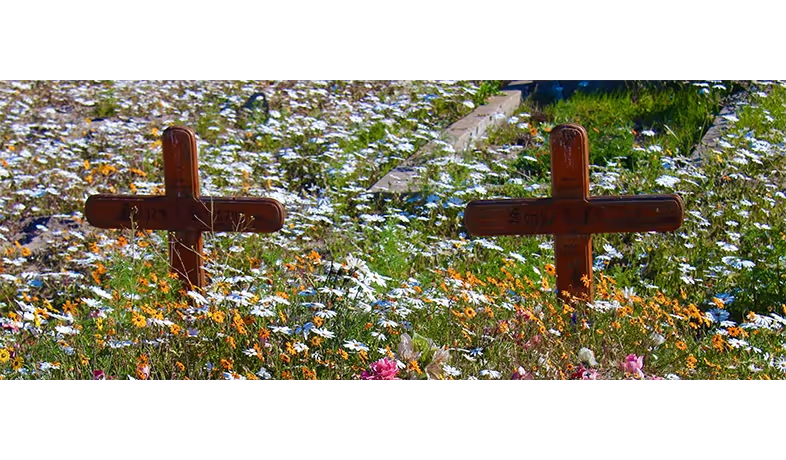
Mrs X’s child developed Acute myeloid leukemia and died. Her marriage could not bear the emotional strain, and she and her husband divorced 18 months after the funeral. Mrs X became antisocial and severely depressed, was on various medications, saw various counsellors and specialists and eventually had Electro Convulsive Treatment (ECT) under anaesthetic with doubtful benefit. Mrs X not only lost her child, but as a consequence, she also lost her husband, her family, her friends and finally herself. What a tragic escalation of a single incident.
Mr Y was the son of a well-known businessman in town. He was an alcoholic. This was a very embarrassing situation for the family, who put a lot of pressure on the medical team to resolve the issue. Initially, his alcohol abuse was linked to managing stress, dissatisfaction, and unhappiness. The intoxication transported him to a false Happy Place free of anxiety and trouble. But soon, matters became complicated with a secondary layer of severe addiction and regular high-volume drinking to sustain it. When in this state, he felt brave, strong, and in control of everything and everyone. The alcohol dulled his emotions and social conscience, and he would argue, fight, swear, and abuse without any ability to control himself. He always regretted everything the next day, cried in shame, and hated himself even more. So, Mr Y would return daily to the bottle to ease his growing dissatisfaction with himself and the world, continuing the cycle of false Happiness and regret. This became a vicious cycle that perpetuated itself over time, worsening the problem. I sensed that the risks were increasing and tried to build a trusting relationship. But in the end, he hated himself even more for disappointing me and everyone else in his life. It all ended in tragedy.
Drugs and alcohol are easy vehicles to help us escape from our harsh reality. They take away the personal pressure to resolve issues that might be difficult or even impossible to fix and instead offer an escape route that calms our discontent and disconnects us from our unrelenting reality. It takes us to a phantom place of pseudo-happiness that is so delightful at the time that it becomes difficult not to revisit this place again and again. The problem is that this delusional solution always makes the real-life problem infinitely more complex, never resolves any issues, and often destroys relationships, support structures, and even the role-players themselves.
Let’s examine the case of Miss Z to illustrate the impact of the problem further.
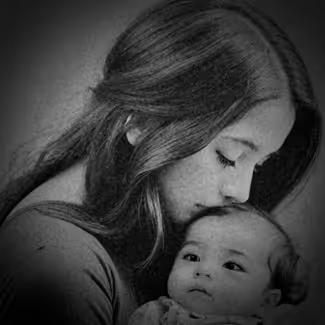
The young mother hushed her child against her breast. We will call her Miss Z.
She asked to be detoxed from her addiction. She did not know the father of her child, and her family rejected her years ago. She had needle marks on her arms and legs, but also on her neck. One side of her face was paralysed from a stroke caused by her drug use.
I admitted her to the hospital and started her on a rehabilitation program that involved replacing her IV drugs with an alternative oral drug administered on a weaning protocol.
A few days later, on the eve of Christmas, her pension was paid into her bank account. At midnight, she took her meagre belongings and her little girl, climbed through the window of the ward and disappeared into the night.
I covered my face with my hands when I realised that she had played me. She ran out of money to support her addiction. She opted for the less effective alternative of the oral drugs in my rehabilitation program to help her through until the next government handout. The worst, however, was the innocent unhappiness in the little girl’s eyes that haunted me. Where would this story end for her?
Now, I know this is tough on you, Dear Reader, especially if you can relate to some of the stories. However, this is the reality of many trapped in the shadows around us. Many of us are slipping to the bottom of the see-saw and then get stuck. We try the tricks and finally might create a phantom world of Happiness to claim our moment in the sun.
But then the bubble bursts, as it always does. Too often, this reinforces an escape pattern with detrimental consequences. If only we could maintain the presence of mind to trust someone to reach us and help us regain perspective and control. That is the threshold of Happiness.
Finally, Mr Alpha demonstrates the detrimental intensity the challenges of life can have, stripping us of all joy and pushing us to the very edge.
Mr Alpha snatched open the front door, stormed past Reception, down the corridor and banged open the door to my consulting room. The lady in consultation on the chair next to my desk shrank into her chair, protecting her face with her arms.
I’m done, Doc, Mr Alpha shouted in an angry voice.
I’ve had enough of all your pills and your stories and all the rest of your mob. I just came in to tell you that it is all over. This is the end.
Mr Alpha was in his 50s, went bankrupt, and lost his business, his house, and his wife. His children and his friends all “turned against him,” he said.
This world is a very unfair place, he went on. I am a failure, and there is nothing your mob can do about it. And don’t even dream of coming after me or sending the police, he went on. I will shoot them all.
He slammed the door shut, stormed out of the surgery in a rage, and left with smoke from his screaming tyres.
Mr Alpha went home and killed himself.
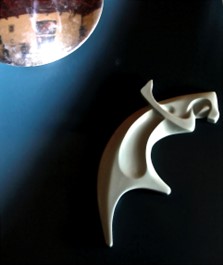
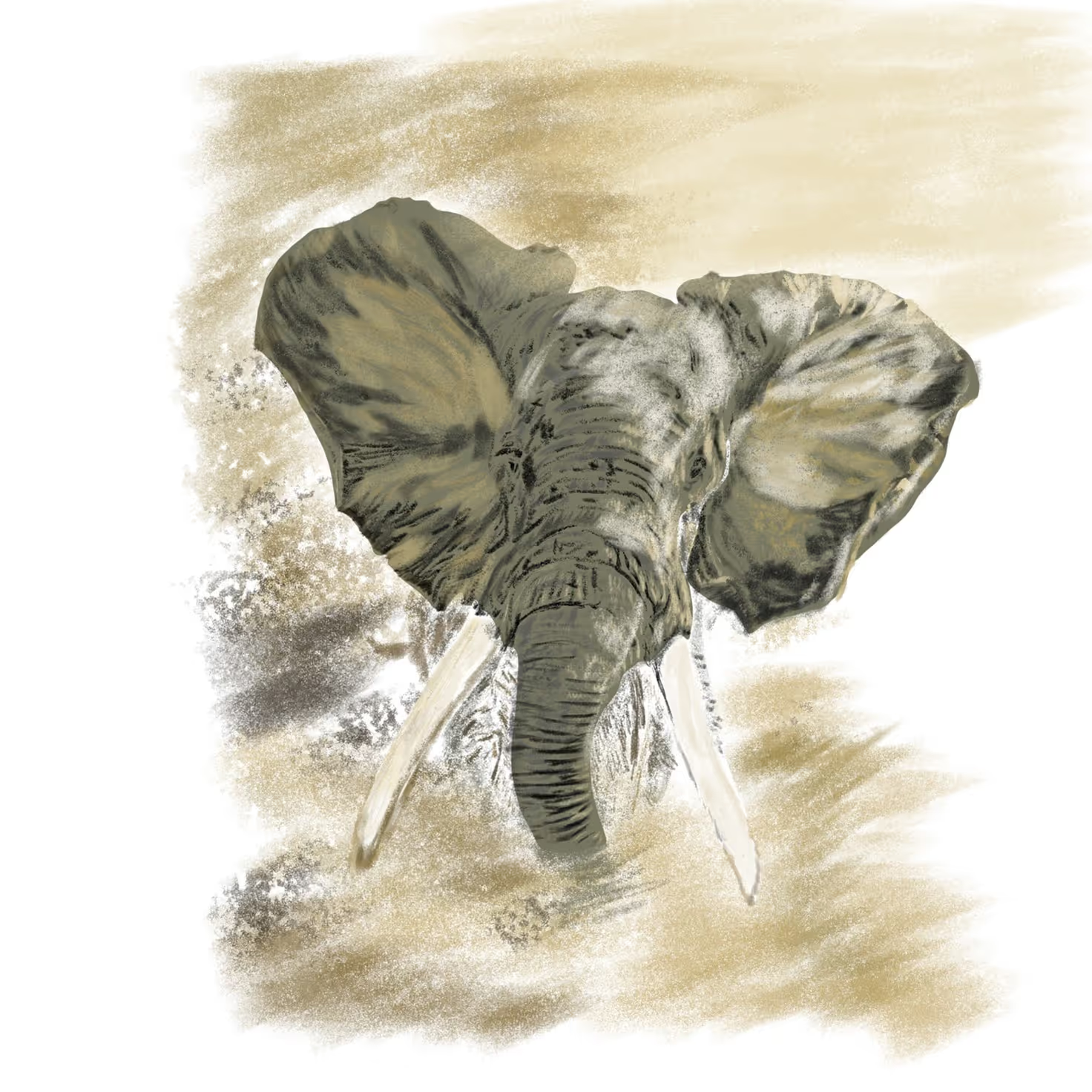
This artwork hung high on the wall in our sitting room. Dad explained that we, humans, are contracted to the Light like a moth to a candle.
I think he was talking about God.
But then we balk and start to circle, question and even reject.
He said it is part of our nature and it strips us of meaning and Happiness.
Thank you for sharing the burden of these unfortunate yet precious people with me. They all despised themselves, their life and the opportunity to live. Yet, irrespective of their actions or achievements, they count the same on the value axis of life, as you and I. If only they could accept themselves and their fate, ignore the mirage on the horizon, and slowly work through the issues of life, like a tractor ploughing a field.
So, what went wrong?
What stripped away their Happiness?
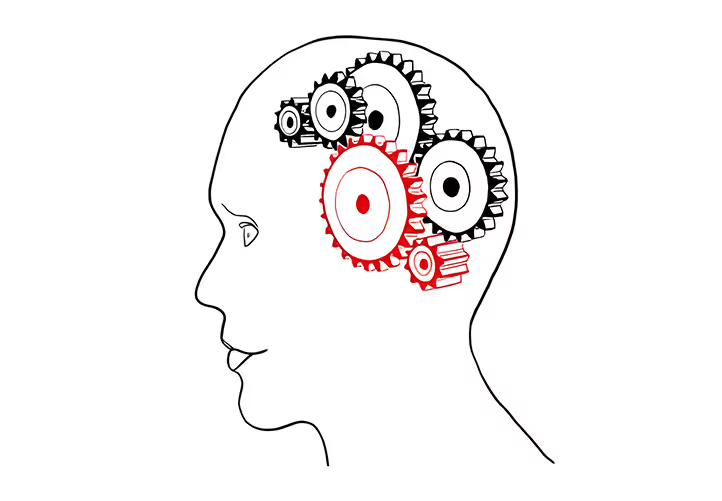
The clever people describe Happiness as a perception that is the function of biological, psychological and cultural phenomena.
When we encounter rewarding experiences like laughter with loved ones, a quiet sunrise, or achieving a hard-won goal, we are biologically rewarded by a shower of neurotransmitters like dopamine and serotonin that reward us with Happiness. Yet, the mind’s hedonic treadmill ensures these peaks fade again. The serum levels will reset to baseline, and that will leave us craving for more again later.
Culturally, Happiness is a chameleon. In collectivist societies, it’s tied to community and duty; in individualistic ones, to personal achievement. Yet, across contexts, it’s less about what we chase and more about what we cultivate—small, intentional acts like savouring a meal or helping a stranger.
Psychologically, Happiness thrives in meaning, not excess. Studies, like those from positive psychology, show it blooms from gratitude, relationships, and aligning actions with personal values. The pursuit of external markers of success, such as wealth, status, achievement, or perfection, often distorts Happiness and creates an unfortunate rebound of the see-saw. Societal pressures develop a myriad of "shoulds" that obscure authentic joy.
Happiness requires accepting life’s impermanence, embracing both light and shadow without clinging to either.
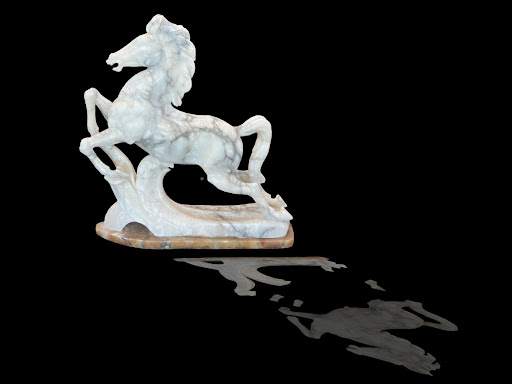
If we succumb to the enticing attractions of success and tie the strings of our Happiness to the manes of this wild horse, the reality of life becomes a menace and a curse.
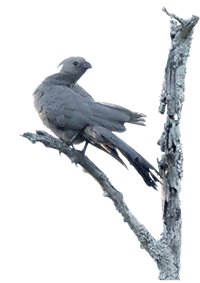
Dad told the story of the grey Go-away-bird (Crinifer concolor).
Mankwe Lake is near the centre of the crater of an extinct volcano known as the Pilanesberg Alkaline Ring Complex. It was a late Sunday afternoon, and Mum and Dad were having a picnic next to the lake. It was going to be the perfect sunset with the green grass lapping on the shores of the lake after the first rains. The sky was blue with a few lazy clouds floating in perfect white plumes over the mirror. The sun, yellow and friendly, sharing his glow and warmth in pure gold.
Dad poured a glass of wine, and they drank to the perfect moment. As their glasses met in a toast, a Go-away-bird landed on a dead branch of a tree nearby. He flicked his crest and aimed his head in all directions in curious inspection as all go-away-birds do when they move from tree to tree. The birds usually move around in pairs or flocks, but this one was on its own.
He looked at the strange creatures on the green grass, at the yellow sun, and the white clouds. And then his eyes fixed on the mysterious but perfect upside-down world reflected in the lake. This world was shining and bright, the likes of which he had never seen before. The trees were lusher, the grass greener, and the sky bluer than the dull world he was used to. Suddenly, the dry stick he was sitting on became irritating and rough. It made his claws ache. Why didn’t he notice this place long ago and explore this perfect world? But, at least he could do it now and then go back to fetch the rest of the flock to come and enjoy this place.
In the final inspection, he aimed his head again in all directions and flicked his crest. In critical moments like this, one can’t afford to make a mistake!
And then he took off for the mirage in the lake, to the land on the lush green grass of his dreams.
So, the Go-away-bird landed in the water, about a hundred yards from the shore, Dad told. But these birds are meant to sit on tree-tops and on real grass, not in water, because they cannot swim.
So, the Go-away-bird drowned at sundown in the beautiful Mankwe lake.
And the magic eye of the sun skimmed his last mesmerising beams over the mirage of his making, unperturbed by the bird drowning in the upside-down world of his dreams.
Let’s return to the lonely Springbok on the scorched Etosha plains.
The ram in his prime years is in excellent condition. He might well be the dominant ram of the herd. So, why does he prefer to lie out here alone, chewing his cud in the winter sun?
Well, I would like to think that this ram knows exactly how his Happy Place works!
Look at the photo again. The heat of the sun converted his grazing and mating fields into an island in the skies beyond the horizon of the great plains. The ram lies with its back to the utopia in heaven. But he keeps an eye on the shimmering mirage, well aware that he will return there to graze and mate; to fight the other rams in the herd; to flee from the lions and packs of Wild painted dogs (Lycaon pictus) and the cunning leopard stalking in the night. But the solitude and safety of this Happy Place is where he gets rest and perspective, where he figures out strategy, where he becomes his own best friend. This lonely Happy Place keeps him in balance, gives him strength and wisdom, and makes him Happy! But other than the joy and exhilaration of winning a battle and serving a doe, this place leaves him content.
Without this balance, he would burn out and become cranky and irrational. He would sense his loss of control and lose his confidence. Then he would start losing his battles, and finally, the doe would despise him.
When we arrive at the dark side, and we all do, it is time to go back to the principles of joy, the simple truths and values of life. Linger there for a long while, while chewing the cud. Such is the reality of Happiness.
Next Time:
After the heavy load, we will go light again.
And let’s go so light that we lift off into the space of the birds!

the place we live
The Song of Tap
an ode to the senses







.png)









Not a subscriber yet?
Click here to subscribe - it's free
Share to a friend
Take a moment to pass along the story to a friend or family. Your recommendation might be exactly what someone in your circle needs to read today. The best stories are those that bring people together.
I'd love to know your thoughts about this story, feel free to leave a comment.
.svg)
.svg)
Lorem ipsum dolor sit amet, consectetur adipiscing elit. Suspendisse varius enim in eros elementum tristique. Duis cursus, mi quis viverra ornare, eros dolor interdum nulla, ut commodo diam libero vitae erat. Aenean faucibus nibh et justo cursus id rutrum lorem imperdiet. Nunc ut sem vitae risus tristique posuere.
