
Modi Thabeng (Close to the Mountains)
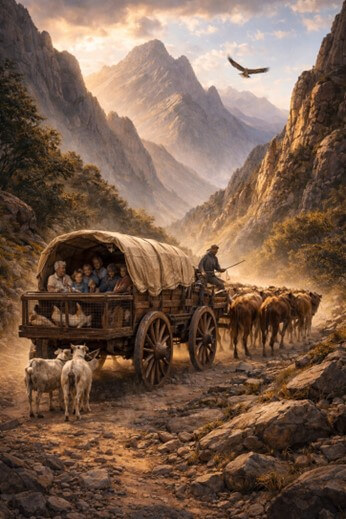
The oxwagon slowly crawls up the steep slopes of the Grootrivierberge (Big River Mountains). The steel rims around the wagon wheels grip and slip, grip and slip over the quartz boulders, then ease forward as they crush sandstone and shale to powder under the weight of the load. The wood and steel of the wagon frame contort and sway as the sixteen oxen lean their weight and muscle against the yoke. Their hooves clattering over the rocks like a crazy metronome, conducting the cacophony of squeaks and screeches from axles and hubs, wheels and joists, sending the calls high up in the clear summer skies. The false tunes reverberate off the cliffs and caves around the mountain pass. A Fish Eagle catches the strangeness on the high winds above the peaks and swerves around to observe the journey.
Under the wagon swings the chicken pen with five lay-hens, their egg-laying program confused by the hazardous, swaying world around them. Behind the wagon, trotting reluctantly at the end of three rawhide ropes, are two goats and a lamb. They clearly feel this journey will not end well for them. On top of the wagon under the tent sail are Ouma Connie and seven children, including my father as a boy. Oupa Jan is exploring ahead of the wagon on horseback, and Oom Charlie, the driver, is perched on the wakis (wagon chest) whip in hand, swaying with each jolt over rocks.
It is the year 1926. The family is on a seven-day journey through 4 mountain ranges, travelling from the farm at Steytlerville to Jeffreys Bay for a rare holiday at the beach.
Zoom forward forty years, and I will try to draw a picture in your mind.
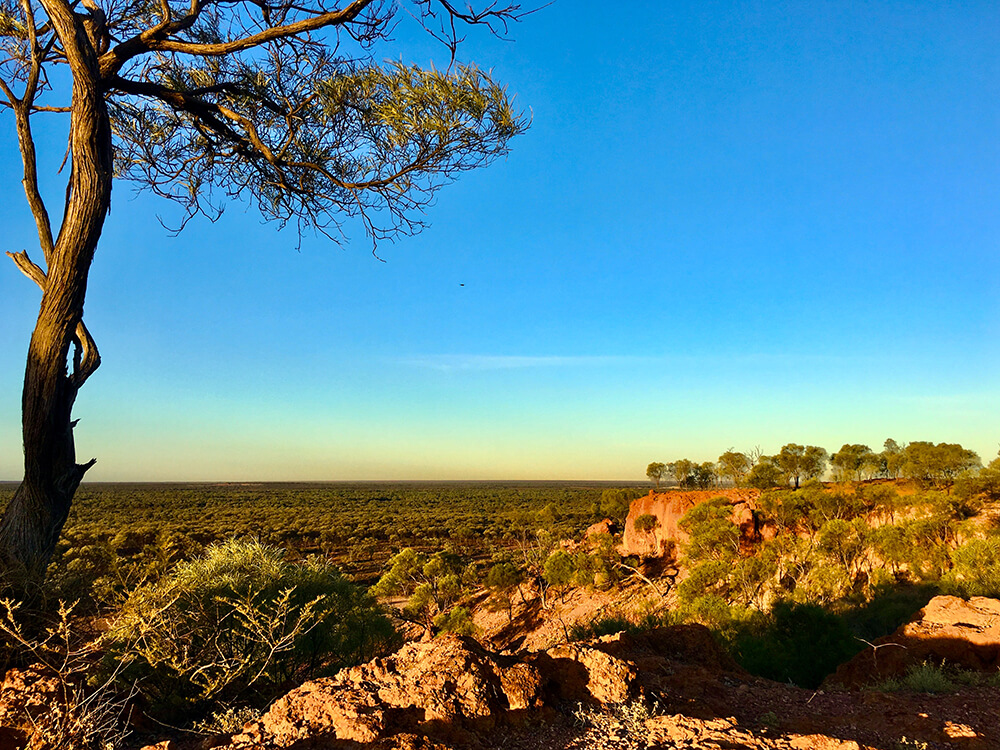
The yellow Valiant is heading south through the semi-desert of the Karoo plains. On board are Mum, Dad, and the five boys. We are travelling from our home in the North for our yearly holiday at the coast near Jeffreys Bay. The Karoo bossies (short desert bushes) stretch East and West as far as the eye can see.
But to the South lie the mountains.
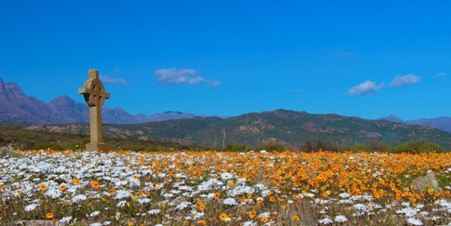
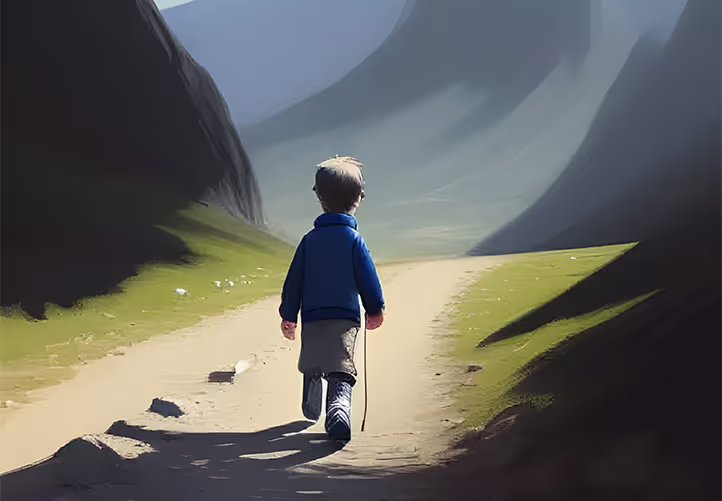
The Cape Fold Mountains block the horizon like a bold, blue barrier. At first small and vague, like a cloud touching the earth, but later larger and darker like a dream becoming reality. And finally, when the majesty reached its most profound, the barrier broke open into a corridor that let us in and through.
Life's issues can be like mountains, Dad explained. From far away, they appear surreal in their faint blue veil. But as we get closer, they seem to block the way, with nowhere to go. And as we close in, they grow formidable and overwhelming. But that is when the detail becomes clear and the reality changes. If you stay determined and of good faith, the mountain pass will open up and let you through.
Mum and Dad retired at Jeffreys Bay with its white sand, the black rocks, and the sea. Above the front door, Dad built a blue mountain at the end of a plain with mosaic blocks and printed the name Modi Thabeng, "Close to the Mountains." And Dad said: We are now only a touch away from our final journey across the mountains.
One of my favourite lines of consultation and intervention was dealing with pregnancy and then delivering the baby. This must be one of the most fascinating journeys to watch and share. At first, the new mother-to-be is euphoric about the positive pregnancy test. She embraces her husband, jumps with joy and announces to the whole world that they are destined to become a mum and dad! But then she talks to her friends and her mum, and slowly the issue of birthing enters her mind. She thinks about the size of newborn babies and her own anatomy. And as the size of her girth grows, so do her doubts and hesitations. She seeks assurances from her mother, the doctor, the midwife, and her friends. She considers requesting a cesarean section to avoid the birth process and thinks about the excuses she could offer for the request. And then she feels guilty for doubting her abilities. Mum and some of her best friends braved the process and cherish the memories. And as the time goes on, the discomfort gets worse, and the child somewhere in her body stirs and rolls and comes to lie next to her heart. And the doctor tells her, “It could be any time now. This is what you should do”.
And the mountain becomes huge and its majesty profound.
But suddenly it is as if she understands it all.
And the woman feels excited, secure, and inspired all at once.
Suddenly, she finds that she cannot wait to get it all over with.
Then the time strikes.
She accepts instructions, she anticipates the waves of pain, she grabs and screams and bears with all her might. And then, in sweat and tears and blood, the miracle of birth happens.
And the baby that grew out of her body and her love folds in her arms and suckles against her breast.
I am now in my older years, a Skin Cancer Doctor. The skin is not only the largest organ in our bodies, but it is also fully visible, carries our history and displays it for the whole world to see. It will tell whether our ancestors came from the polar regions or the equator, display the moles and birthmarks we inherited, and indicate whether we tend to spend our time indoors or outdoors. And then come the tattoos, studs, and gold, silver, and precious stone decorations. But most interestingly are the scars and the stories behind the scars.
However, even more intriguing is the way our skin carries and displays beauty. When young, the skin is smooth, shiny and soft, well-suited to our state of innocence and lack of exposure and experience. And the crowds will cheer the long-legged catwalks, gasp at the subtly exposing fashion displays and openly marvel at the beauty of Miss Universe.
But time and life will batter and bruise. The proud pregnancy will pass, leaving a pruned belly and stretch marks behind. The elegant breasts in shades of pink will droop in brown. The high, smooth cheekbones will display chloasma in tones of brown and grey. And the woman will despise the mirror, resenting her changing body and skin. But then, a fascinating transition starts, and the mature woman slowly emancipates. The authority of motherhood, marital fulfilment, and social status will be established with all the evidence for the change on display. These middle years introduce the real beauty and maturity I love. It carries with it an air of wisdom and love, care and sacrifice, elegance and contentment that become the hallmarks of community influence and leadership.
But the clock on the wall spins the dial unnoticed and without mercy.
The lady in the chair in my consulting room is Ann. Ann is 78 years old.
Good to see you again, Ann! I said with an upbeat voice. What can I do for you today?
Oh, I thought I’d drop in for a skin check, she said thoughtfully.
So, I asked all the questions, and while typing, Ann made herself ready for the examination of her skin. I took her right hand in mine and, using the dermatoscope, began examining her fingers and hands.
Ah, don’t take any notice of those ugly fingers, she said. They are só knobbly from the arthritis!
I moved up her arms.
Just look at all the folds in my skin! She exclaimed, grabbed one of the overlaps and pulled it to a stretch.
Her hair was grey and thin and soft like silk under my fingers.
I reached her face, covered in brown sun blemishes, blending through the wrinkles like shadows on the floor of a dry lake.
Can you do something about my eyelids? She asked. They are sliding over my eyelashes, and I can’t see properly.
Oh yes! And what about these ugly warts growing on the sides of my head? They are disgusting! She exclaimed.
They are barnacles! I laughed. They are tokens of proof that you’ve done the job. You don’t want to get rid of them!
And then I found the cancer on her cheek. It was nearly invisible. A large, invasive basal cell carcinoma.
I gently finished the examination and sat her back in the chair.
You have a nasty carcinoma on your face that we will have to remove, I started. It will have to be cut out. It will leave a scar.
Ann was silent for a while. Then she leaned forward and took my hands between her knuckled fingers. She had a sincere sadness in her eyes when she looked in mine. I don’t care about scars anymore, doctor. You have seen my body. There is more to life than this body of mine. You do what you have to do.
And at that moment, Ann became one of the most beautiful women I have ever met.
You see, beauty is a declaration by the spirit. It does not carry words, nor does it present smooth lines. It simply offers a testimony, the house that harbours the soul.
Finally, I would like to introduce you to Sylvia. Everything about Sylvia was exceptional. The way she moved, the way she spoke to the nursing home residents and cared for her husband and little children. She was meticulous with observations, medications and treatment protocols. She was a natural leader and my favourite nurse in charge of my favourite nursing home.
But then Sylvia fell ill with a degenerative condition that would destroy her body over a few short years. Soon she was admitted to the high care section of her own nursing home, cared for by the staff she used to lead, surrounded by the residents she used to care for. The scene was set for one of the most remarkable endings to life that I have ever witnessed.
Sylvia’s body shrank to a skeleton. The muscles failed and then broke down. Her lower body died, the odour filling the whole unit and beyond. To care for Sylvia became a nearly impossible challenge for all.
One day, one of the teary-eyed young nurses brought in her medication on a tray. When she entered the room, she vomited all over the floor, dropped the medication and broke down sobbing on her knees.
Come sit here with me, Naomi, Sylvia said when the crying had settled.
She offered Naomi the chair next to her bed and a glass of ice water.
You will soon get used to it, and then you will feel better, she said.
And then Sylvia told her how much she appreciated Naomi braving the situation to care for her. She told her that it gets easier when you drink cold water and ease into the smell. She said it wouldn’t be much longer, and then it would all turn into memories. But the courage and love that Naomi demonstrated in caring for her will be an inspiration to all the staff, the residents and all family and friends. And that would become her strength in the years to come.
Sylvia then paged open the Bible at Psalm 23:4 and read to Naomi: Even though I walk through the darkest valley, I will fear no evil, for you are with me; your rod and staff, they comfort me.
Sylvia somehow managed to turn victimhood into an opportunity to inspire and guide her team and everyone who came into contact with her through what might well be the most challenging care setting they would ever encounter.
The atmosphere in the nursing home transformed away from devastation and mourning.
The spirit of Sylvia became nearly visible in the corridors.
And it became Spring in the valley of death.
The last sun slipped over the mosaic blocks and struck an orange glow in the blue mountains.
Dad was still sitting on the rocks long after the sun bowed out. His jacket snug against the cold wind from the south. His cap low over his closed eyes.
I knew he was back on the ox wagon searching his way through the mountains.
The Song of Tap
an ode to the senses




.png)





Not a subscriber yet?
Click here to subscribe - it's free
Share to a friend
Take a moment to pass along the story to a friend or family. Your recommendation might be exactly what someone in your circle needs to read today. The best stories are those that bring people together.
I'd love to know your thoughts about this story, feel free to leave a comment.
.svg)
.svg)
Lorem ipsum dolor sit amet, consectetur adipiscing elit. Suspendisse varius enim in eros elementum tristique. Duis cursus, mi quis viverra ornare, eros dolor interdum nulla, ut commodo diam libero vitae erat. Aenean faucibus nibh et justo cursus id rutrum lorem imperdiet. Nunc ut sem vitae risus tristique posuere.
