
The Marble Horse
To be brave in misfortune is to be worthy of manhood; to be wise
in misfortune is to conquer fate - Agnes Repplier
This story is dedicated to all men big and small in the hope that we might be able to understand our own hearts a little better
Five Boys spell out competition: Who is the strongest? Who is the toughest? Who can last the longest? Who has the highest pain threshold? And so it goes.
The dad of Five Boys has it tough. What constitutes law and order, and how do you maintain it? How do you protect precious property? How do you defuse conflict? How do you teach respect? What is fair and what is unfair? And so it goes.
For instance, no one is allowed to run in the house.
However, the L-shaped corridor, the veranda, the dining room and the kitchen form the ideal circuit for laps. If you start skidding early enough on the red polished floor of the verandah, you could make the corner into the dining room without a detrimental hit to the glass display cabinet containing mum and dad’s precious collections from around the country and the world.
The only problem is competition entails pride and proud achievement is to be fiercely defended. So the laps get faster and faster, the skidding distance shorter and shorter. And then the inevitable.
The hit is done by Gysbert. He is my oldest brother - and has much to lose in any fierce competition. He hits the glass cabinet with only 25% of control over his momentum. He aims his right shoulder at the wooden frame between the two glass doors to contain the impending disaster. It works. The glass doors stay intact. But the remaining impact falls under the uncontrolled 75%. He is in damage control mode. The cupboard sways wildly; the contents fly and crush. His hands snatched wildly through the air, catching the Zulu warrior as he dives over the edge, but loses it again as both hands are needed to grab the glass swan following directly behind.
And then the Zulu crashed on the floor in 54 pieces. Only 51 pieces could be retrieved.
The rest of the afternoon was spent by 5 boys united in the dedicated and very delicate job of piecing the warrior back to life, gluing all his parts together again before Dad came back from work.
And then Dad came, sat down and read his newspaper before dinner.
Gysbert: “Dad, there was a little accident”
Dad (looking up with an angry frown, indicating that he heard it all before): “What accident?”
Gysbert: “The Zulu fell off the cabinet”
Dad: “Just like that?”
Gysbert: “I think he became a bit unstable, Dad”
The rest of the team standing behind Gysbert shaking their heads in absolute agreement.
Dad: “Why did he become unstable?”
Gysbert: “Dad, the guy who made the Zulu made his feet too small. He can’t stand properly on them. He keeps wobbling”
The rest of the team nodded again. Gysbert is wording it perfectly.
But Dad must have been a boy in his earlier life, because, somehow, he knows it all. He always does. His next question was debilitating.
Dad: “Did you run in the house?”
Gysbert looked at the floor. We all looked at the floor.
Gysbert finally, in a faint voice: “We did run a little bit, Dad”
There were two things understood between men big and small in our household:
No 1: There is no way that the patchwork of the Zulu would withstand any decency test. Trying to mend it, however, was respectful and essential.
No 2: All endeavours have implications and all implications were supposed to be part of the risk calculation at the start of the challenge. You always have the choice to opt out. No one ever liked this option.
So Dad inspected the warrior, shook his head, threw it in the bin and fetched the horse cane. Dad's sjambok served two purposes shared 50/50 between the bums of Sterling, our exceptionally lazy gelding, and our overzealous bums. We lined up, took the hiding, apologised for the broken Zulu and thanked Dad for his equitable judgement. That is how it was. It was a fair outcome. Next time, the calculations and risk assessment must be done better.
The door clicked close, and we gazed bum-against-wall into the semi-darkness. It’s game on. Five enormous wasp nests hung from the ceiling of the old store room. The huge red wasps move nervously around, watching every move of every boy - their composite eyes flashing yellow. The rules are simple: You choose your own defence. Usually a branch with just the right size to still allow optimal agility and just enough leaves to not slur but not miss either. If you can’t handle the stings any more, you can take the door. The last man standing is the winner.
That night mum would look at the three puffed-up faces around the dinner table. “And what happened to you three?”, she would ask.
The oldest answers: “We just ran into a few wasps, Mum. We’ll be fine for school again tomorrow”
“One, two, three, go!” The wild donkeys are pushed against a dense bush. Each one jumps a donkey and holds on for dear life. The one to stay on board the longest is the winner.
And so on, and so on.
But now I have to tell you about the Marble Horse.
You see, if the challenge is really big, exceptionally big, it has to go to the oldest.
When the thought came into my mind, a chill went down my back, and I struggled to swallow.
Finally, I got it out: “Gysbert, I bet you wouldn’t throw Dad’s Marble Horse down the balcony onto the sand heap below”
Gysbert looked at me in disbelief, then briefly glanced at the shining white horse on the sitting room table next to Dad’s chair. He covered his face with his hands and muttered: “No, no way! This is madness”
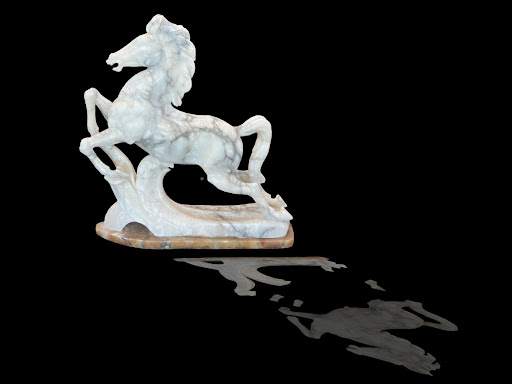
The Marble Horse was Dad’s pride and joy. It was hand-sculpted by Professor C Rossi, whom Dad personally met, and brought it from Johannesburg a few years prior. It was beautiful.
“It might not be as mad as you think”, I said encouragingly.
“Come and have a look over here.”
We all crowded over the railings looking down at the sand heap below.
And then more than an hour of deliberations and calculations followed. Finally we all agreed that this could be done with a reasonable chance of success. Failure would be detrimental. Bums are only bums, but it could be that not even Dad would be able to comprehend what was at stake here.
The far slope of the sand hill was at about 45 degrees and 4 meters away from the building. The sieved sand was carefully inspected and contained no particles larger than 3- 4 mm. It was freshly dumped and, on touch, moved with little resistance.
The edge of the railing was 4 meters above the far slope, and this could be diminished by 50 cm by leaning over the rails. If the horse would hit the slope at exactly 45 degrees, footing first with the head 20cm from the top of the sand heap, it should stop skidding down the slope about 10cm before hitting the concrete driveway.
This was, without a doubt, the scariest challenge of all time.
We all carefully ushered the stallion to the balcony and finally over the railing, making sure that Gysbert had a firm grip with his right hand on the tail and hind legs, and his left hand on the front legs and stand. Some monitored his angle from below next to the sand heap and others from the sides. He slowly moved forward and backward while maintaining all the correct angles.
All was set to go.
Gysbert’s face was as white as the railing of the balcony. Cold sweat pearled on his forehead. He came forward with the last perfect swing and let go.
The horse floated slowly through the air, nearly as if he wanted to fly away like a white heron or even Snow-White from the storybook. That is if she could fly.
And then he hit the far slope of the sand hill, 20cm from the top at exactly 45 degrees, footing first.
The Marble Horse skidded down the sand slope and stopped its slide 10cm from the concrete slab–intact without a single scratch!
Five Pairs of hands carefully lifted the horse out of the sand, dusted him clean and carried him back to the sitting room. He stood back on the table next to Dad’s chair, his shimmering beauty more pure than ever. But for us he would never be the same horse again. From that day onwards it was no longer Dad's Marble Horse. It was ours. The horse had become proof that impossible things could sometimes succeed if enough courage—and perhaps enough foolishness—stood behind them. And the best of all, he would keep our secret safe.
Dad died many, many years later, still unaware of the Great Challenge.
Gysbert inherited the Marble Horse. All brothers agreed that this is how it should be. To write this story, I visited my brother to photograph the horse.
I carefully lifted the horse out of the niche in his sitting room and placed it on the thick, soft carpet.
The morning sun sparkled on the marble manes and over the broad chest and onto the strong rump. I placed the stallion at an angle to get the full impact of the sun on the horse.
And then the 60-year-old horse gently rolled over and shattered into pieces.
Thanks for your company!
And, hold your horses, next time …
Oh yes, and by the way, we glued the pieces of the horse together again.
You won’t be able to spot the mend!
The Song of Tap
an ode to the senses




.png)





Not a subscriber yet?
Click here to subscribe - it's free
Share to a friend
Take a moment to pass along the story to a friend or family. Your recommendation might be exactly what someone in your circle needs to read today. The best stories are those that bring people together.
I'd love to know your thoughts about this story, feel free to leave a comment.
.svg)
.svg)
Lorem ipsum dolor sit amet, consectetur adipiscing elit. Suspendisse varius enim in eros elementum tristique. Duis cursus, mi quis viverra ornare, eros dolor interdum nulla, ut commodo diam libero vitae erat. Aenean faucibus nibh et justo cursus id rutrum lorem imperdiet. Nunc ut sem vitae risus tristique posuere.
