
North of Black Rock
It sounded like this: Nick, Nick, pause, knock, pause, knock, knock.
I looked up. It was almost as if the sounds carried different messages and came from different directions.
I said nothing, pushed my chair back, walked over and pushed open the Monday morning door.
Two white men? I was nearly shocked. Except for half a hand of exceptions, there were no white people around that I knew of. But even more peculiar, they were both standing sideways and looked at me over their left shoulders.
I later learned the tall guy was Matt, and the short guy was Mooney. Matt had red hair, pockmarks on his red face, and his beard was having a struggle.
D-d-d-d, sorry to b-b-b bother, Doc. His eyes were wide with the struggle.
I thought his contribution was the “nick” part of the knocking.
And then Mooney interrupted. Mooney’s beard was quite a bit more successful.
Despite a slightly darker complexion, his face, arms and legs were also red from sunburn.
Mooney’s voice sounded more confident, and as he said the words, it sounded like a revelation: “Doc, you see…” and he looked up over his left shoulder at Matt, who was looking down at him over his own left shoulder. And when their eyes met, he got strength and wisdom to say the right thing.
So, he started again: “You see, Doc? We went fishing at Black Rock over the weekend”.
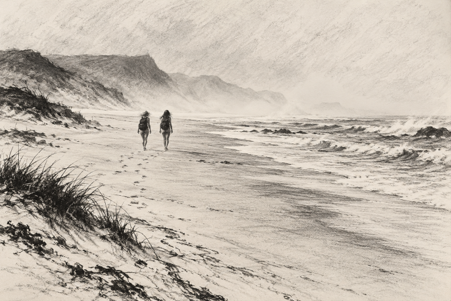
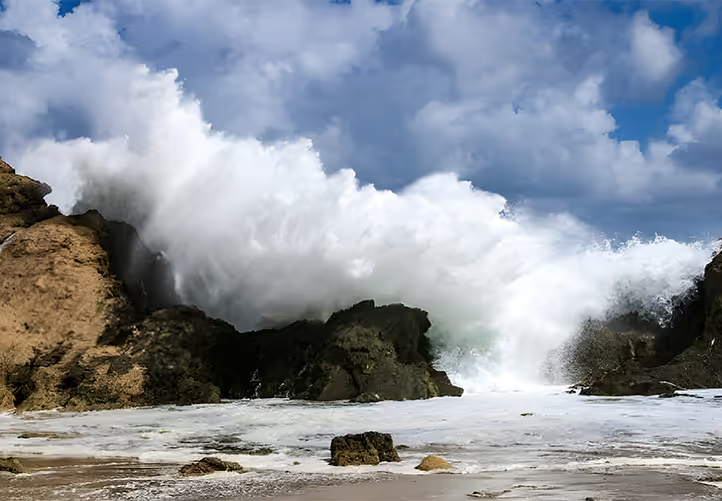
North of Black Rock, the skirt of the ocean froth a straight leg for as far as the eye can see. Jarred between the waves and the dunes is the beach, frilled by the tropical cover of the Makatini sands. From the air, it is quite spectacular. The Kosi Lake system stretches north and east toward Ponta do Ouro in Mozambique. Despite millennia of relentless onslaught, the ocean has not managed to break through the narrow isthmus protecting the lakes’ tranquil waters. Fiercely guarded by hippos and crocodiles, the black waters hold their dark secrets only a stone's throw away from the crystal-clear seas.
A story was told about a 4x4 enthusiast from the city who drove his brand-new Land Rover along the beach, north of Black Rock. The tide came in, squashed him against the dunes and slowly eroded the sand from beneath his sea-facing wheels. The vehicle leaned towards the relentless ocean and finally tipped over. The waves rushed around and rolled their prey down the slope and away into the depths.
But this only happens to visitors from the city. Locals are more clever. They carefully work out the pitfalls and plan their way around them.
So we are heading north at low tide. The tyres of the old Ford F250 purr on the firm, wet sand. The engine growls evenly. No coughing or spluttering like when we were climbing the dunes before. My brother Charl came to visit and brought his spear-fishing friend Carl along.
We only have a two-hour window, guys; we have to get back before the tide turns, I said, making the conditions quite clear. But in my chest was an unease.
When the diving is good, time flies like a seagull on the wind. One moment it hovers above your head, but the next it slides out of sight on a gust.
Not so long ago, my brother Gys and I were diving in the same spot. We took the rubber duck out far onto the reef and emerged into the timeless beauty. At first we couldn't find each other, and then we couldn't find the boat. The tide came in, lifted the anchor, and floated the rubber boat away. We had to swim a couple of kilometres to reach the shore.
So two hours became three hours, became three-and-a-half hours. I finally rounded Charl and Carl up, loaded all the gear, spun the Ford around and stopped.
We have a problem, guys, I said unnecessarily.
As far as the eye could see, the beach to the south was swamped by the incoming tide.
We looked at the spectacle stretching out to where the beach and the waves became one, disappearing in the distant spray and fog rolling in from the sea.
It was quiet for a long while.
We’ll just have to push in and try to get through it, I said.
There is no other way out.
The early moon rose over the sea to the east. She touched a full circle like a pregnancy. The spring tide's strength showed her power on the waves.
A soft yellow was creeping into her white profile. It would be dark soon.
We will hold back when the waves come in and charge when they recede, I said.
Windows down and no seat belts.
It will be tough.
So it became a serious rugby match final between the Springboks and the All Blacks. Tactics were everything. We attacked on signs of weakness and bolstered on signs of enemy strength. But soon the waves came in staggered, and when one retreated, his mate charged in. Soon the Ford shook under the onslaught, the waves crashing over the bonnet. We retreated up the slope of a dune to seek reprieve, planning to run down again when the wave pulled back.
But then it happened. As we ran up the slope, the Ford coughed, choked and died.
The carburettor flooded! I shouted above the roar of the waves. She does that under the strain of climbing a dune. It is an old trick of hers to pull out of hard work.
My two passengers looked at my Pride and Joy as if she were a donkey. But then, after all, I rescued her from a scrap yard in Durban.
She has had a hard life.
A wave hit the Ford on the side in full force. She shuddered but stood her ground.
We will have to be quick and manually drain the carburettor, I said. I jumped out, opened the bonnet and started the familiar job on the double. I took off the air filter, removed all six screws holding the carburettor together and carefully stored them securely in my pocket. I pushed an old rag into the flooded bottom compartment and soaked up the fuel. I bent the neck of the float down to discourage flooding and put it all back together again, as quickly as I could.
She started up like a new Mercedes, and we rushed back into battle.
After winning some ground, we were caught in crossfire. We rushed up the slope of a dune to safer ground, and the same process repeated itself.
My two assistants now knew the drill and assisted eagerly.
Is this going to happen the whole time? Charl asked, looking away down the busy beach. The waves were now coming and going at great speed, rushing up the slopes of the dunes as if confident to conquer.
I ignored his question and said instead: We’ll chuck the air filter in the back so it’s easier to reach the carburettor next time.
We all jumped back in and attacked with a roar, swamped by the noise of the ocean.
She shivered, shook and attacked bravely but was soon caught off guard by a cross wave. The water splashed through the seaside window, and we backed off to higher ground.
We will have to take the float off to force-bend the neck further down, I said when she died. We worked with feverish hands. I bent over the hot engine and soaked the carburettor once more. I then pulled the needle and seat apart, took the float in my hands and bent the neck down to more than 120 degrees. I leaned over again to carefully put it all together again when it happened.
At the last moment, the needle and seat slipped out of my hands, fell through the large gaps in the engine and landed on the wet sand beneath. Before I could twitch a finger, a wave came and washed them away into the sea.
This stretch of the Makatini Coast was a popular nesting ground for sea turtles.
Usually, loggerhead turtles. But one night, I watched a Leatherback Turtle lay her eggs. When she finished and covered her eggs with sand, she slowly crawled back down the dune to the water. When the first wave hit her, she paused for a moment to savour the clean and fresh water. She then lifted her massive black-and-white body and slumped away into the sea. The waves slowly covered her up and claimed her as their own.
I forcefully suppressed the image, for the leatherback in my mind turned into my one and only black-and-white Ford, slowly disappearing into the waves.
It was crunch time.
I ran to the back of the Ford and came back with two Coke bottles, a pair of pliers and a piece of fencing wire.
We will have to back off quickly in reverse, guys. There is no way we can turn around on this narrow strip. We can reach high ground there on a gentler slope.
But how are we going to get her going again? Carl asked. As he spoke, a wave nearly took his legs out from under him, wetting him to the waist. As the wave drew back, the Ford sagged on the seaside as the tactics of the sea started to set in.
They both looked at the meagre tools in my hands.
So, we quickly disconnected the fuel line from the carburettor and filled the two Coke bottles. I then kinked the supply line and firmly tied it closed with the wire.
We’ll leave the carburettor open and the bonnet up.
Charl, fill the carburettor with the fuel from the Coke bottle and run next to the Ford. When I feel the power drop back, I’ll shout. Dive in over the engine and refill the carburettor. The fuel will spray with the fan's wind. Keep the bottle spout close to the cup, fill it and get back out from under the bonnet as soon as you can. We will have to do it on the run. Watch out for the waves. We have about 500 metres to go.
If the attack was spectacular, the retreat was mind-boggling. Charl ran next to the Ford with his Coke bottle of fuel to keep her going as she broke backwards through the waves, up the beach, and back to safety.
We slowly relaxed again as the fire got going on the pale white sands.
The yellow flames leaked up to the now matching yellow moon above. I inspected her broad face closely. And as I looked, the grey bones in her face pulled her mouth into a smile.
I wonder how we’ll get home in the morning, I muttered, surveying the few tools in our toolbox. And then my eye fell on a small screwdriver. I picked it up and studied it in the firelight. The shaft must be nearly the exact thickness of the needle. What if I could break it between two pliers at about the same length as the combination of the needle and seat was with the spring relaxed?
Perhaps I could slip it into the carburettor and see if it would go in the morning.
And until today I still wonder why the Americans had to build the carburettor so complicated.
For until the end of her life, the Ford ran up and down the dunes of the Makatini never to cough or choke again. And all this with a short piece of screwdriver in the carburettor, taking the place of the needle and seat.
No good standing in the doorway talking, I said and invited Matt and Mooney into my consulting room. Both shuffled sideways through the doorway so that they could see where they were going. Mooney took the first chair in front of the desk and turned it 90 degrees to the right. He then sat down and looked at me over his left shoulder. Matt followed in his tracks, positioned his chair exactly like his mate’s and joined the disjointed consultation.
And what is wrong with you two guys that you walk about like two ghost crabs on a sandy beach? I asked, not trying to hide a smile.
We don’t know, Doc; that’s why we are here.
It looked as if Mooney was going to do the talking.
But then Matt came in from the side: D-d-d-d, sorry to b-b-b bother, Doc. We will t-t-t-t tell you what happened, then you can d-d-d-d decide what happened for yourself.
So, Mooney explained in detail how they volunteered to work on the Makatini road section in order to fish at Black Rock. They’d heard great stories about fishing at Black Rock since childhood, and now the dream had finally come true. They borrowed a work vehicle over the weekend, collected bait and set it all up.
After fishing for about half an hour, Matt said, I think there is a p-p-p person on the beach, Mooney.
Impossible, Mooney said. We are the only people in the whole area.
See that s-s-s spot on the far end of the beach, Mooney?. I think that is a p-p-p-p person, Matt persisted.
So they kept fishing and, every now and then, looked to the left up the beach to monitor the situation.
Suddenly Matt announced: M-m-m-m Mooney, there are t-t-t two people on the beach now.
Impossible, Mooney said. Where would they come from? There is no other way up there than to come past us!
So they kept fishing. But now they mostly watched the beach and only looked back now and again to see how the fishing was going.
That's when Matt struggled to stop stuttering. M-m-m-m-m-m Mooney, they are both white g-g-g-g-g girls, Mooney!
Impossible, impossible! Mooney persisted. Where would they come from?
So the fishing was forgotten.
Both Matt and Mooney stared over their shoulders at the two figures strolling down the beach towards them, each with a backpack on their shoulders.
Finally, Matt whispered in a hoarse voice: M-m-m-m Mooney, they do not have any c-c-c-c clothes on.
And that is how it was.
For some reason, the remote African bush became a great attraction for Europe's crème de la crème. So, in those years, Manguzi Hospital on the Kosi Lakes became a major drawcard for affluent French medical students wanting to experience wild Africa. So, in the spring of 1984, Camille and Margaux arrived. And to put this straight, they were clever, charming, built like goddesses and made no attempt to hide any of their assets.
So, Camille and Margaux casually passed behind the backs of the two fishermen on the rocks. Matt and Mooney followed every step of the two French goddesses over their left shoulders and twisted until they could twist no more.
And that was where the necks of Matt and Mooney got stuck.
The Song of Tap
an ode to the senses




.png)




Not a subscriber yet?
Click here to subscribe - it's free
Share to a friend
Take a moment to pass along the story to a friend or family. Your recommendation might be exactly what someone in your circle needs to read today. The best stories are those that bring people together.
I'd love to know your thoughts about this story, feel free to leave a comment.
.svg)
.svg)
Lorem ipsum dolor sit amet, consectetur adipiscing elit. Suspendisse varius enim in eros elementum tristique. Duis cursus, mi quis viverra ornare, eros dolor interdum nulla, ut commodo diam libero vitae erat. Aenean faucibus nibh et justo cursus id rutrum lorem imperdiet. Nunc ut sem vitae risus tristique posuere.
